
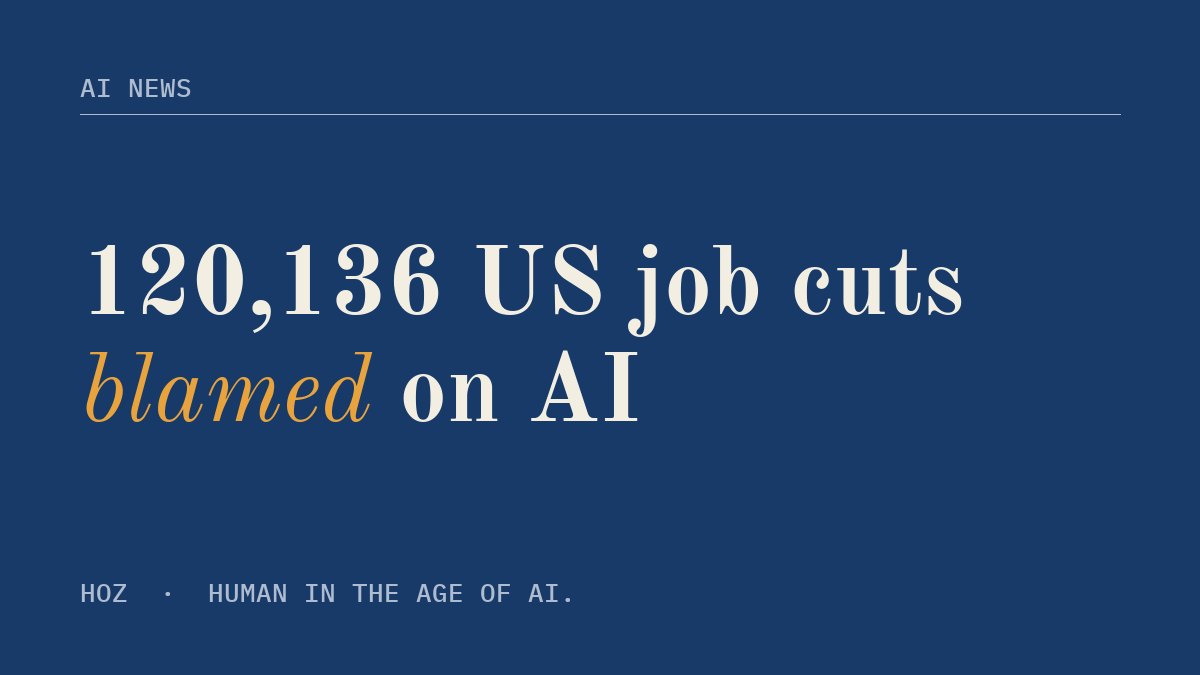
AI job losses are now on record: employers blamed AI for 120,136 announced US job cuts through September 2026, about 21% of all cuts and the top reason given, Challenger data reported by Fortune shows. Entry-level job postings have fallen by up to 73% in four years, Harvard Business School reports, while the AI 2027 report forecasts 'superhuman' coding systems by March 2027.
Key facts
- Employers cited AI in 120,136 announced US job cuts through September 2026 — about 21% of all cuts and the top reason given, according to Challenger job-cuts data reported by Fortune. (source)
- 7.4 million US workers were displaced from their jobs between 2023 and 2025, up from 6.3 million in 2021–2023, US federal jobs statistics (BLS) show. (source)
- Entry-level job postings fell by up to 73% over four years, Harvard Business School research found. (source)
- Anthropic chief executive Dario Amodei has forecast AI could wipe out half of white-collar jobs and push unemployment to 20%, Stanford researchers noted. (source)
- The AI 2027 report predicts hiring of new programmers will have 'nearly stopped' by July 2027 as coding automation accelerates. (source)
How many jobs have been lost to AI?
Employers cited AI in 120,136 announced job cuts in the United States through September 2026 — about 21% of all cuts and the single biggest reason given, according to Challenger job-cuts data reported by Fortune. US federal jobs statistics (BLS) recorded 7.4 million workers displaced from their jobs between 2023 and 2025, up from 6.3 million in the previous two years.
Stanford researchers found the picture looks less dramatic once the whole economy is counted. Unemployment for workers most exposed to AI rose by 0.77 percentage points between 2022 and 2026, against a 0.85 percentage point rise for the least exposed — a gap that points to broader economic softening rather than AI alone.
What jobs will AI replace by 2030?
The clearest predicted losses are in software engineering and other entry-level, computer-based roles, according to both industry forecasts and labour-market data. The scenario-planning report AI 2027, written by researchers including former OpenAI researcher Daniel Kokotajlo, predicts that 'superhuman' coding systems will arrive by March 2027. By July 2027, the report says, hiring of new programmers will have 'nearly stopped'; earlier in its timeline, it says AI systems 'can do everything taught by a CS degree.'
Harvard Business School research found entry-level job postings have fallen by up to 73% over four years. Stanford's Digital Economy Lab research, cited by Fortune, puts employment for 22- to 25-year-olds in AI-exposed fields about 19% below expected levels.
What happens to people who lose their jobs to AI?
Workers displaced because of AI took about a month longer to find new jobs than other displaced workers, and were roughly 10 percentage points more likely to still be unemployed a year after losing their job, Goldman Sachs economist Pierfrancesco Mei found.
The gap widens with age. Workers aged 35 and over took five weeks longer to return to work, against three weeks for those under 35. Only 49% of rehired workers earned as much or more than before, down from 62% in the previous BLS survey of workers displaced in 2021–2023.
Will there be job losses due to AI?
Yes, but how large and how fast remains disputed. Only one in five US firms used AI in production, Census data cited by Stanford researchers shows, and just one-third of companies' AI experiments succeed, Harvard Business School found. A National Bureau of Economic Research paper, reported by Harvard Business School, puts the worst case at about 3 million workers, or 2% of the labour force, out of work at the same time.
Longer-range predictions are starker. Stanford researchers noted that Anthropic chief executive Dario Amodei has forecast that AI could wipe out half of white-collar jobs and push unemployment to 20%. The AI 2027 report predicts that AI's economic impact over the next decade will exceed that of the Industrial Revolution.
What are people saying about AI job losses?
On Reddit's r/UKJobs, a thread titled 'AI to be blamed for more job losses…' had drawn more than 300 comments at the time of writing, as shown in Google's search results. On YouTube, Al Jazeera's Inside Story asked 'Why is the UK at the forefront of AI-driven job cuts?'
Watch Hoz tell it in under a minute
Questions people ask
- What is the AI 2027 report?
- AI 2027 is a scenario-planning report published on 3 April 2025 by Daniel Kokotajlo, Scott Alexander, Thomas Larsen, Eli Lifland and Romeo Dean. It predicts that the economic impact of superhuman AI over the next decade will exceed that of the Industrial Revolution, with 'superhuman' coding systems arriving by March 2027.
- Which jobs are most at risk from AI?
- The clearest risk identified by the sources is in entry-level, computer-based roles. Harvard Business School found entry-level job postings down by up to 73% over four years, and Stanford's Digital Economy Lab research, cited by Fortune, puts employment for 22- to 25-year-olds in AI-exposed fields about 19% below expected levels.
- How many jobs has AI created?
- None of the sources behind this story give a single net jobs-created figure. Stanford researchers found employment grew by 10% at firms that had adopted AI, and Harvard Business School found 52% of executives expect AI to increase entry-level hiring rather than cut it.
- Will people cope if AI takes their jobs?
- Harvard Kennedy School's Doug Elmendorf said job losses from AI are 'very likely' but added that 'most — not all, but most — of those people will be able to find new work.' In practice, Goldman Sachs found AI-displaced workers take longer to find new jobs and often return on lower pay.
- How long until AI takes all jobs?
- None of the sources give a date for AI taking all jobs. Current research finds only limited AI-specific job losses so far, while the AI 2027 report's most dramatic predictions — including an artificial superintelligence by December 2027 — apply to AI capability, not to full job replacement.
- What are the job displacement due to AI statistics?
- Employers cited AI in 120,136 announced US job cuts through September 2026, about 21% of all cuts, according to Challenger data reported by Fortune. Entry-level job postings fell by up to 73% over four years, Harvard Business School reports, and only one in five US firms used AI in production, Census data cited by Stanford researchers shows.
- What are the layoffs due to AI in 2026?
- Through September 2026, employers named AI as the reason for 120,136 announced US job cuts, the top reason given in the Challenger data reported by Fortune. Stanford researchers say the wider data points to broader economic softening, not AI alone.
More AI news from Hoz
Read next: Robot dog walker job: Dimensional advertised $20 an hour for humans; AgiBot humanoid robot left the store and did not come back; Worker caught faking sick after he copied the AI's question.
See every AI news story on this site, or meet Hoz, a human in the Age of AI.
Sources
- AI 2027 scenario report by Daniel Kokotajlo, Scott Alexander, Thomas Larsen, Eli Lifland and Romeo Dean
- Harvard Business School Working Knowledge on why AI hasn't caused mass layoffs yet
- Fortune report on Goldman Sachs research into AI-linked layoffs and Challenger/BLS data
- Stanford SIEPR policy brief separating AI jobs hype from current data
- Reddit r/UKJobs thread reaction, as shown in Google's search results
- Al Jazeera Inside Story video on UK AI job cuts, as shown in Google's search results